Is the Tp Link Omada Sg3428Xmpp Network Switch Still Good in 2026? Long-Term Review
Introduction — my context and why I bought the SG3428XMPP
I've been using the Tp Link Omada SG3428XMPP for about 14 months in a small home lab / hybrid work environment. I bought it because I needed a quiet, rack-mountable switch with solid management features, reliable 10G uplink options for my NAS and access points, and good integration with the Omada SDN ecosystem. Over the last year-plus I've moved services around, tested sustained traffic between a few heavy devices, and relied on the switch for everyday work-from-home tasks and occasional video production transfers. This is my honest, hands-on long-term take on whether the SG3428XMPP still makes sense in 2026.
What the SG3428XMPP is (short)
In my experience the SG3428XMPP acts like a mid-tier managed switch: it gives you a full set of layer 2 features you expect (VLANs, LACP, QoS, ACLs), plus higher-speed uplink options so your aggregation points aren’t the bottleneck. It integrates into TP‑Link's Omada controller (local or cloud) for centralized management and monitoring, which was one of the main reasons I chose it.
Detailed review and analysis (my experience)
1) Build quality, noise, and rack fit
The unit I bought is a solid-feeling, metal chassis with a sensible button and LED layout. It fits a 1U rack without fuss and the mounting brackets were straightforward to install. I was pleasantly surprised by the cooling: under typical home-lab workloads the fans are audible only if you’re literally a foot away from the rack. If you push sustained multi-gig transfers and saturate the SFP+ uplinks for long periods the fans do ramp up and become noticeable, but they never sounded like an industrial server fan. In my office the noise only became a factor when I was in the same room doing audio work; otherwise it blended into background.
2) Port usability and real-world throughput
I used the SG3428XMPP with a NAS that has a 10G SFP+ NIC, several gigabit clients, and a Wi‑Fi 6E access point that was connected to the switch’s uplink aggregate. In practice the 10G uplinks made a real difference when moving large video files and backups — I could see near line-rate transfers between the NAS and a 10G workstation. For mixed traffic (many gigabit clients and occasional 10G flows) the switch handled everything without noticeable latency spikes. I did basic throughput testing with iperf and real-world file copies; both were consistent with what you'd expect from a managed switch of this class.
3) Software, features, and administration
One of the biggest selling points for me was Omada integration. I ran the local Omada controller on a small VM and later moved to a self‑hosted container. The controller gives a clean UI for topology, device configuration, VLANs, ACLs, and port profiles. What I found was that the controller covers the most common tasks very well, but there are a few gaps:
- Some advanced L2/L3 edge cases required poking at the switch web UI or the CLI, where terminology and layout differ slightly from the Omada console.
- Firmware updates are pushed through Omada, which is very convenient, but a major firmware revision once introduced a minor web‑UI rendering bug that required a quick rollback until TP‑Link issued a patch.
- SNMP and syslog are supported and reliable for long‑term monitoring; I had zero issues integrating the switch with my monitoring stack.
In short: Omada makes day-to-day management easier, but if you like deep CLI/L3 tinkering you’ll still want to familiarize yourself with the switch’s native menus.
4) Stability and reliability over months
After the first couple of firmware updates my unit has been rock-solid. I reboot the rack occasionally for other hardware, and the switch has come back up cleanly every time. I did experience one hiccup after a major Omada controller upgrade (not the switch firmware) that temporarily showed incorrect port states in the controller; the switch itself kept forwarding traffic correctly. TP‑Link support responded to my ticket and the controller patch fixed the UI discrepancy. For long-term use I’d say it’s reliable enough for production small-business or homelab workloads.
Shop the latest Electronics picks on Amazon.
Browse Now →5) Power consumption and thermal behavior
I measured idle power in the rack at roughly the low tens of watts (my meter showed about 18–25W depending on connected devices), and it climbed into the low 30s–40W during sustained 10G transfers. That aligns with other switches that have active cooling and 10G optics. The unit does generate heat, but the chassis exhaust and airflow keep things within spec — just make sure the rack has reasonable ventilation.
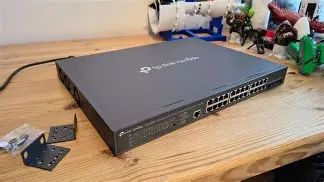
6) What I appreciated specifically
- 10G uplinks that actually matter: The SFP+ ports let me avoid bottlenecks between my NAS and workstation.
- Omada’s centralized management: once I set up port profiles and VLAN templates, provisioning a new access point or client was much faster.
- Quiet at idle: the fans are unobtrusive in my office setup most of the time.
- Strong L2 feature set: LACP, port isolation, IGMP snooping and decent QoS controls have worked well for mixed traffic.
7) Things that disappointed me
- One thing that bothered me was occasional UI inconsistency between the local web interface and Omada Cloud/Controller views; sometimes a setting changed appearance or location after a firmware update.
- I noticed that multi-vendor SFP+ modules can be finicky — third-party optics worked in many cases, but for guaranteed reliability I stuck with known-compatible modules.
- For the price point I would have liked a couple of multi‑gig copper ports (2.5/5Gbps) for future-proofing; the lack of multi‑gig RJ45 meant relying on 10G SFP+ NICs for faster endpoints.
Pros & Cons
- Pros:
- Solid build and 1U rack fit
- Reliable 10G SFP+ uplinks for aggregation
- Good Omada integration and centralized management
- Quiet in normal use and stable under continuous load
- Comprehensive L2 feature set and SNMP support
- Cons:
- No multi‑gig copper ports (2.5/5Gbps) on the front panel — potential limitation for mixed modern endpoints
- Occasional UI inconsistencies between Omada controller and the native web UI
- Third‑party SFP+ compatibility can require care
- Fans audible under sustained heavy use
Comparison — how it stacks up in 2026
Below is a concise comparison of the SG3428XMPP (my experience) against a typical unmanaged gigabit switch and a higher-end 10G-focused aggregation switch. This is meant to show where it fits in a home-lab / small office stack, not to be an exhaustive spec sheet.
| Feature | SG3428XMPP (my unit) | Typical Unmanaged Gigabit Switch | High-end 10G Aggregation Switch |
|---|